
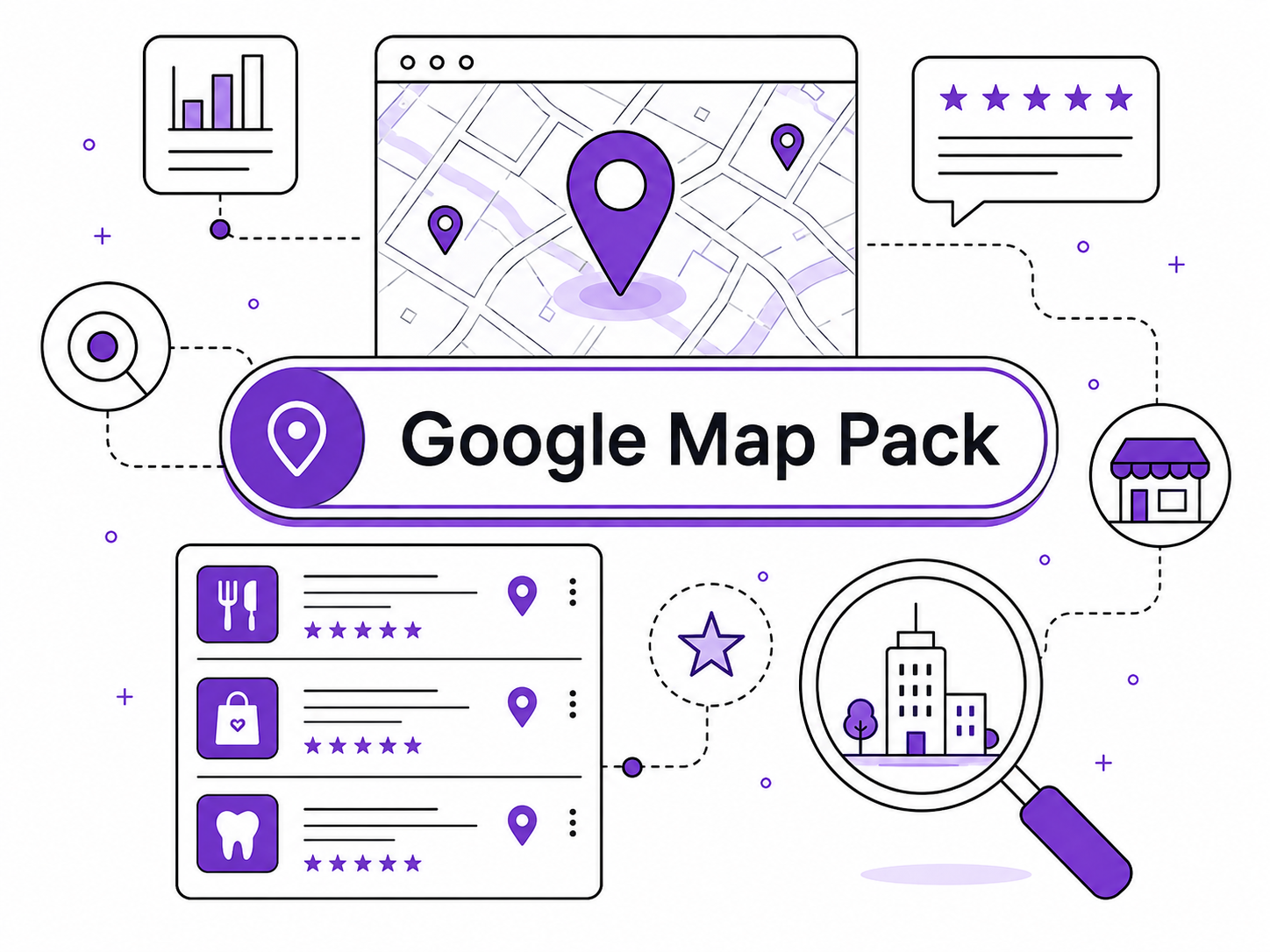
Search for a local service on Google and you’ll usually see more than a standard list of blue links. For searches with local intent, Google often shows a map, a handful of nearby businesses and key details like reviews, opening hours, directions and contact buttons.
That section is commonly known as the Google Map Pack.
For local businesses, it can be one of the most valuable parts of the search results page. If someone is looking for a plumber, accountant, estate agent, restaurant, solicitor or SEO partner in their area, the Map Pack can help them compare options quickly and take action without needing to scroll very far.
In this guide, we’ll explain what the Google Map Pack is, why it matters for SEO and how your content can support better local search visibility.
What is the Google Map Pack?
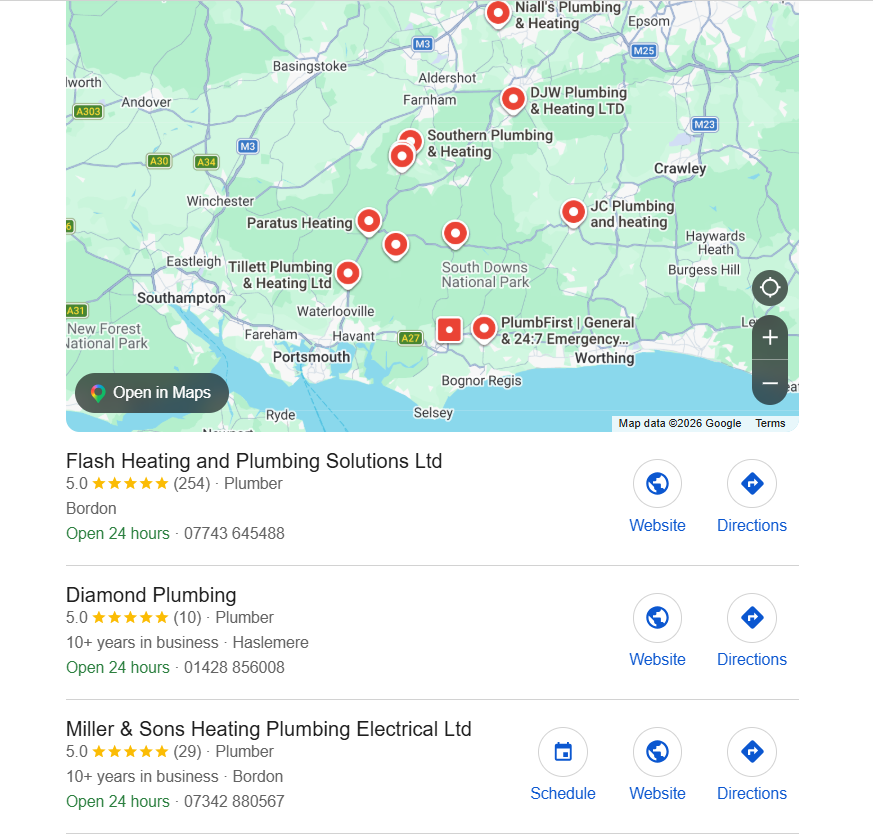
The Google Map Pack is the local business section that appears in Google search results when someone makes a search with local intent.
It usually includes:
- A map showing business locations
- A small selection of local business listings
- Business names
- Review ratings
- Opening hours
- Contact details
- Directions
- Website links
- Google Business Profile information
You may also hear it called the “Local Pack”, “3-Pack” or “Google local pack”. The names vary, but they usually describe the same thing: a map-led group of local results designed to help users find nearby businesses.
For example, if someone searches for “SEO agency near me” or “content agency in London”, Google may decide that local results are useful and display a Map Pack above or among the standard organic listings.
Here’s what it looks like.
Why is the Google Map Pack important for SEO?
The Google Map Pack matters because it appears in a highly visible part of the search results.
For many local searches, users don’t need to visit lots of websites before making a decision. They can see business names, reviews, locations, opening hours and contact options straight away. That makes the Map Pack especially useful for high-intent searches where someone is close to taking action.
Appearing in the Map Pack can help businesses generate:
- More calls
- More direction requests
- More website visits
- More local enquiries
- More trust through reviews
- Better visibility for service-led searches
It also gives smaller local businesses a way to compete for visibility, even when larger national brands dominate the traditional organic listings.
That doesn’t mean the Map Pack replaces standard SEO. The two work together. Your Google Business Profile, local landing pages, service content, reviews and wider site quality can all support how visible your business is in local search.
When does the Google Map Pack appear?
The Map Pack usually appears when Google believes the user wants a local result.
This can happen with obvious local searches like:
- “accountants near me”
- “hairdressers in Reading”
- “best restaurants Manchester”
- “SEO agency Hampshire”
But it can also appear for broader service searches where Google assumes location matters. For example, someone searching “emergency plumber” probably wants a local business, even if they don’t type a place name.
Google uses signals like the search term, the user’s location and the type of service being searched to decide whether a Map Pack should appear.
That’s why local SEO is not just about targeting “near me” keywords. It’s about making sure your business, location and services are clear across your website and Google Business Profile.
What affects Google Map Pack rankings?
Google Map Pack rankings are influenced by several factors, but they broadly come down to relevance, distance and prominence.
- Relevance is about how closely your business matches the search. If someone searches for “SEO content agency”, Google needs to understand that your business offers SEO content services.
- Distance is about how close your business is to the person searching, or to the location they included in their search.
- Prominence is about how well-known, trusted or established your business appears to be. Reviews, links, mentions, business information and overall online presence can all play a role.
Useful areas to focus on include:
- A complete Google Business Profile
- Accurate business categories
- Consistent name, address and phone number details
- Strong customer reviews
- Regular profile updates
- Relevant service pages
- Location-specific content where appropriate
- Clear internal links across your website
This is where your wider SEO activity starts to matter. A well-optimised Google Business Profile helps, but your website still needs to clearly explain what you do, who you help and where you operate.
How can content support Map Pack visibility?
Content can play an important role in local SEO because it gives Google and users more context about your business.
For example, if you offer SEO content support in the UK, your website should make it clear what services you provide, what types of businesses you work with and how those services are delivered. If you serve specific areas, your site should explain that naturally rather than relying on vague location mentions.
Useful content types include:
- Local service pages
- Location landing pages
- Detailed service pages
- FAQs
- Case studies
- Blog posts answering local or service-led questions
- Content refreshes for pages that have lost visibility
The goal is not to stuff place names into every paragraph. It’s to build useful pages that show what you do, where you can help and why you’re relevant for the search.
How do you optimise for the Google Map Pack?
There is no single trick that guarantees Map Pack visibility, but there are practical steps that can improve your chances.
Start with your Google Business Profile. Make sure your business name, website, phone number, address or service area, opening hours and categories are accurate. Add services, photos and a clear business description if they’re relevant.
Then look at your reviews. Reviews are not just useful for rankings. They also help users decide whether to trust you. Encourage happy customers to leave honest reviews and respond to them in a natural, helpful way.
Your website also needs to support your profile. That means having clear service pages, useful copy, relevant internal links and consistent business information.
You can also improve your local SEO by:
- Creating pages for important services
- Keeping old content updated
- Adding FAQs that answer real customer questions
- Linking related pages together
- Making contact details easy to find
- Using descriptive title tags and meta descriptions
- Avoiding thin or duplicated location pages
If your site already has lots of content, it may be worth reviewing what needs to be improved rather than creating new pages straight away. A content refresh can often help existing pages become clearer, more useful and more relevant.
Is the Map Pack different from organic SEO?
Yes, but they are closely connected.
Traditional organic SEO focuses on your website’s visibility in the main search results. Map Pack SEO focuses more heavily on local business information, Google Business Profile signals, reviews, proximity and local relevance.
However, the two should not be treated as separate worlds. Your website still supports your local visibility. If your service pages are unclear, thin or poorly structured, it can make it harder for Google and users to understand what your business offers.
That’s why a strong local SEO approach usually includes both:
- Google Business Profile optimisation
- Review building
- Local citations and consistent details
- Clear service pages
- Helpful supporting content
- Internal linking
- Ongoing content updates
For many businesses, the best approach is to build a clear SEO content strategy that supports both local visibility and wider organic growth.
Can blogs and content help with Google Map Pack SEO?
Simply adding blogs and content alone can’t get you into the Map Pack. But, they’re a vital part of strengthening your presence in local search when they answer useful questions related to your services, location or audience; which can put you well on the way to being included.
For example, a local business might create blogs that explain common customer problems, compare service options or answer questions people ask before making an enquiry.
These blogs can then link back to relevant service pages, helping users move from research to action.
Good blog content can also help you build topical authority. If your site has strong pages around your main services and useful supporting articles around related questions, it becomes easier for search engines to understand what your business is about.
That’s where regular blog post production can support your wider local SEO activity.
How do you know if your Map Pack visibility is improving?
You can track Map Pack performance in a few different ways.
Useful places to look include:
- Google Business Profile insights
- Google Search Console
- Local rank tracking tools
- Website traffic from local landing pages
- Calls and contact form enquiries
- Direction requests
- Review growth
- Clicks from Google Business Profile
It’s worth remembering that Map Pack rankings can change depending on where the user is searching from. Someone searching in one town may see different results from someone a few miles away.
That’s why performance should be judged across a mix of visibility, traffic and enquiries rather than one ranking screenshot.
Why the Google Map Pack matters for local businesses
The Google Map Pack is important because it catches people at a moment where they are actively looking for a business, service or solution nearby.
For local and service-led businesses, that visibility can make a real difference. It can help you appear earlier in the search journey, build trust through reviews and turn local searches into calls, visits and enquiries.
But Map Pack visibility rarely comes from one thing alone. It’s usually the result of clear business information, a well-maintained Google Business Profile, strong reviews, useful service pages and consistent SEO activity.
Need help improving your local SEO content?
QueryQuill helps businesses create SEO content that supports visibility, rankings and real commercial goals.
From landing pages and blog posts to content refreshes and topical maps, we can help you build a clearer, more useful website around the searches that matter.
Explore our SEO content services or book a call to talk through what you need.
Leave a Reply