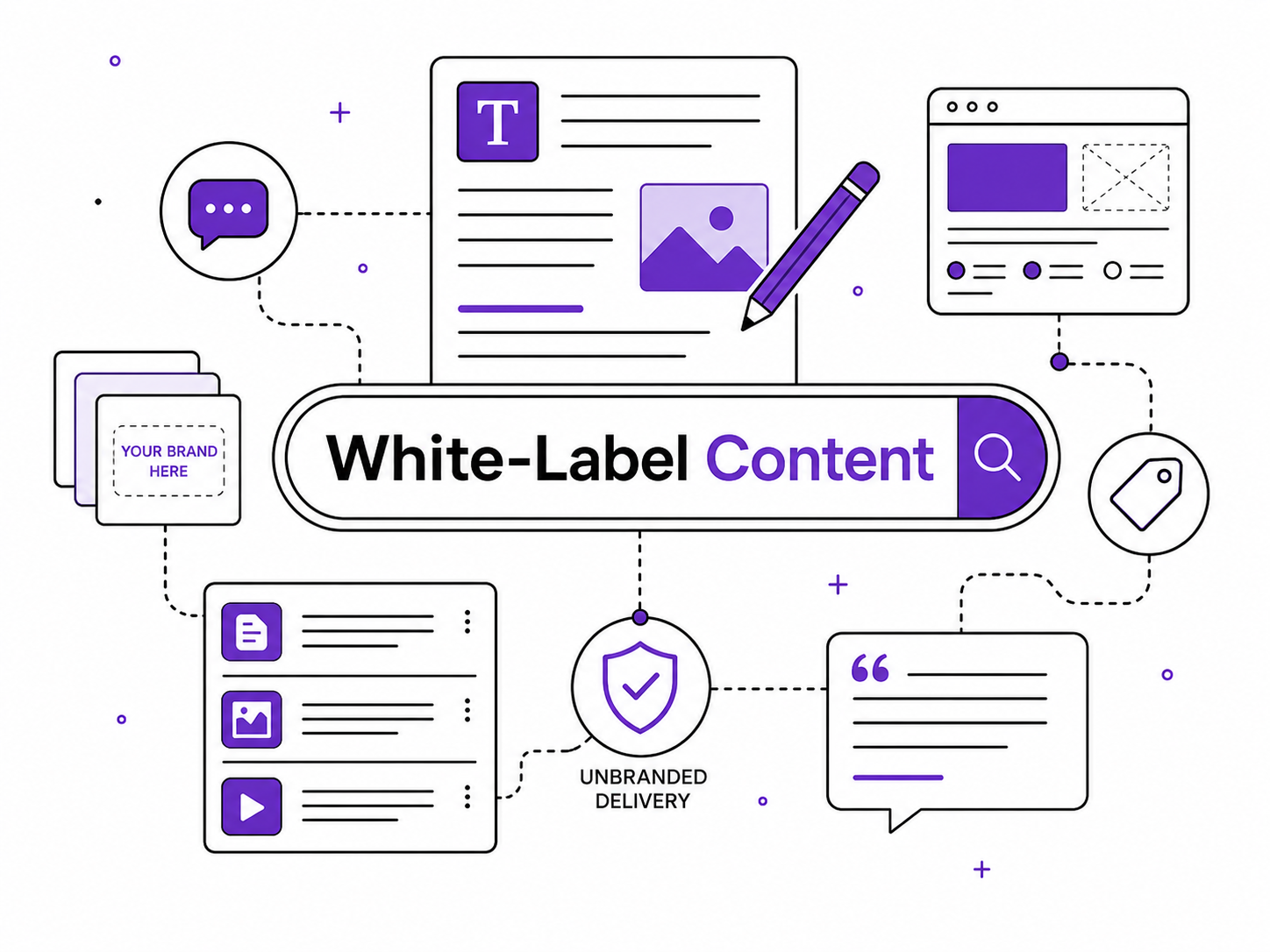
White-label content is content created by one business and supplied to another to sell or present under its own brand.
For agencies, it provides a way to offer services such as website copy, SEO content writing and blog production without hiring a permanent in-house content team. The external provider completes the work behind the scenes, while the agency retains control of the client relationship.
This can be particularly useful for agencies that have growing content requirements, need specialist expertise or want to expand their services without significantly increasing internal headcount.
In this guide, we’ll explain what white-label content means, how the arrangement works in practice, its advantages and potential drawbacks, and what to consider when choosing a white-label partner.
What does white-label content mean?
White-label content is created by an external provider but delivered under another company’s brand.
The company buying the content can then present it to its own clients without the external provider’s branding appearing on the finished work.
For example, imagine a web design agency wins a project to build a new website. The client also requires keyword research, a proposed sitemap and copy for 20 pages.
The agency doesn’t have an internal SEO content team, so it works with a white-label provider instead.
The provider could complete the research and content while the web agency:
- manages the relationship with the client
- agrees the scope and final price
- reviews the work before delivery
- presents the finished content
- manages client feedback
- remains the client’s main point of contact
To the end client, the content forms part of the agency’s overall service. That’s the basic idea behind white-label content services: the agency keeps ownership of the relationship while bringing in additional expertise behind the scenes.
How does white-label content work?
The exact arrangement depends on the agency and provider, but a typical project follows four stages.
1. The agency identifies what needs to be outsourced
An agency may need additional support because it doesn’t offer content internally, has temporarily reached capacity or requires expertise that its existing team doesn’t have.
The work being outsourced could range from one landing page to an entire website or an ongoing content programme.
The agency should decide from the outset which responsibilities it wants to retain and which it expects the white-label provider to handle.
2. The agency briefs the white-label partner
The provider needs enough information to understand both the client and the purpose of the work.
A useful brief could include:
- information about the business
- target audiences
- project objectives
- target keywords
- existing research
- brand and tone-of-voice guidelines
- competitor information
- important products or services
- formatting requirements
- deadlines
- the agreed review process
The better the brief and onboarding process, the easier it is for an external provider to produce work that feels consistent with the client’s existing brand.
3. The provider completes the work
The white-label partner researches, produces and reviews the agreed deliverables.
Depending on the arrangement, this could involve everything from keyword research and content planning through to writing, editing and optimisation.
Deliverables are normally supplied without the provider’s branding and can be placed into the agency’s preferred templates or documentation.
4. The agency reviews and delivers the work
The agency remains responsible for the client relationship.
It can review the content internally, request any agreed revisions and then deliver or publish the final version.
Some white-label providers remain completely behind the scenes. Others may join meetings or communicate with clients as an introduced member of the agency’s extended team.
Both models can work. What matters is agreeing the arrangement before the project begins.
What is the difference between white-label content and outsourcing?
White-label content is a form of outsourcing, but the terms don’t mean exactly the same thing.
When a company outsources content, it simply pays somebody outside the business to create it.
The external writer or agency may be visible to the end client.
With white-label content, the work is specifically produced so another business can supply it under its own brand.
For example:
| Model | Who produces the content? | Who manages the client? | Whose brand is used? |
|---|---|---|---|
| White-label content | External provider | Usually the agency | Agency |
| General outsourcing | Freelancer or external provider | Varies | Varies |
| Ghostwriting | External writer | Usually the commissioning business | Named person or business |
| In-house content | Employee | Employer | Employer |
The distinction becomes particularly important for marketing, SEO, design and web agencies that want to add content to their existing services without referring the work elsewhere.
What can be white-labelled?
Almost any form of digital content can be delivered through a white-label arrangement.
Common examples include:
- website copy
- landing pages
- blog articles
- guides and resources
- category copy
- case studies
- thought-leadership content
- content briefs
- keyword research
- content strategies
- content refreshes
The provider doesn’t necessarily need to deliver all of these services.
Some agencies simply need additional writing capacity. Others may want a partner that can support a broader programme, including research, strategy and ongoing B2B content marketing for their clients.
The right model depends on what the agency already handles internally and where external support adds the most value.
A practical example of white-label content
Suppose a web development agency has been commissioned to redesign a B2B company’s website.
The project includes 25 service and sector pages, but the client’s existing copy is outdated and the web agency doesn’t provide SEO content internally.
Instead of asking the client to find another supplier, the agency brings in a white-label content partner.
The arrangement might look like this:
The web agency handles:
- client communication
- website design
- development
- project management
- approvals
- final invoicing
The white-label partner handles:
- keyword research
- competitor research
- page recommendations
- content briefs
- website copy
- metadata
- editorial review
The completed content is returned to the web agency for review before being placed into the website or sent to the client.
The web agency can therefore offer a more complete website project without recruiting a permanent content team or introducing another supplier into the client relationship.
What are the benefits of white-label content?
There are several reasons agencies use white-label partners.
Add a service without recruiting
Building an internal content team requires permanent salaries, management time, recruitment and training.
White-label support allows an agency to access additional expertise when required without immediately taking on those fixed costs.
Manage changes in capacity
Agency workloads aren’t always predictable.
One month may be relatively quiet while another includes several website builds, content campaigns or new retainers at once.
A white-label partner can provide additional capacity during busier periods without requiring the agency to permanently increase its team.
Keep projects with your agency
Without content capabilities, an agency may have to tell clients to source copy, SEO research or blog production elsewhere.
That can make projects more complicated and introduces another supplier into the relationship.
White-label delivery allows more of the project to remain within the agency’s overall offering.
Create another revenue stream
White-label services are generally supplied to the agency at an agreed partner rate.
The agency can then set its own client-facing price based on the scope of the project, the amount of account management involved and its own commercial model.
Access specialist skills
Sometimes the issue isn’t capacity at all.
An agency may already employ writers but need additional expertise for a specialist project, SEO campaign or larger strategic piece of work.
A white-label relationship can fill those gaps without requiring every capability to exist internally.
What are the disadvantages of white-label content?
White-label content isn’t automatically the right solution for every agency.
There are also potential drawbacks to consider.
You give up some direct control
The work is being completed outside your internal team, so you need confidence in the provider’s processes and quality standards.
A cheap provider that requires substantial rewriting can quickly become more expensive than it initially appears.
The provider needs a good brief
External specialists aren’t automatically going to know everything your account managers know about a client.
If important positioning, audience or tone-of-voice information isn’t communicated, the resulting content may miss the mark.
Good onboarding is therefore an important part of a successful white-label relationship.
Poor quality reflects on your agency
The provider may create the content, but your agency is putting its name behind it.
That means weak research, missed deadlines or inconsistent writing ultimately affect your relationship with the client.
Revisions can affect profitability
White-label content can create an additional revenue stream, but margins need to account for account management, internal review and revisions.
An arrangement without a clearly defined scope or revision process can easily create more work than anticipated.
White-label content vs hiring a freelancer
Freelancers and white-label providers can both provide external content support, and there’s considerable overlap between the two models.
The difference is often in how the relationship is structured.
A freelancer may simply be commissioned to write a particular article or webpage.
A dedicated white-label partner is more likely to work within the agency’s existing processes, understand how work is presented to clients and support multiple projects or accounts over time.
Neither model is inherently better.
For occasional standalone pieces, an established freelancer may be all that’s required.
For agencies looking to add content as an ongoing service, a more structured white-label partnership may make delivery easier to manage.
How much does white-label content cost?
There isn’t one standard pricing model for white-label content.
Providers may charge:
- per article or webpage
- per project
- by day or hour
- through a monthly retainer
- using agreed agency or partner rates
The cheapest rate isn’t necessarily the most commercially attractive option.
Agencies also need to consider how much internal work will be required to brief, review, edit and manage the content.
A more expensive provider that can reliably return work ready for client review may ultimately be easier to scale than a low-cost provider requiring extensive internal editing.
For larger projects, it’s also worth agreeing exactly what is included in the price, such as research, briefing, revisions, editing, metadata and project management.
How do you choose a white-label content provider?
The right partner should fit both your clients’ requirements and the way your agency operates.
Before committing to a longer-term arrangement, consider the following.
Quality control
Find out how content is researched, written and reviewed before delivery.
If you’re selling the work under your agency’s brand, you need to understand who is responsible for ensuring it meets the agreed standard.
SEO understanding
If the content is being produced as part of an SEO campaign, writing ability alone isn’t enough.
The provider should understand search intent, keyword targeting, page purpose, internal linking and how individual assets support the wider website.
That becomes particularly important when you’re outsourcing SEO-led content rather than simply looking for extra writing capacity.
Communication
A provider might produce excellent work but still create problems if communication is unreliable.
Agree how briefs, queries, revisions and deadlines will be managed before increasing the volume of work.
Capacity
Make sure the provider can realistically support the amount of content you intend to outsource.
A partner that works well for two articles a month may not necessarily have the processes required for a 50-page website project.
Confidentiality
White-label relationships often involve access to client documents, plans and commercially sensitive information.
Both parties should be clear about how information is handled and whether the provider can mention the work publicly.
Revision process
Agree what constitutes a revision, how many rounds are included and how substantial changes in scope will be handled.
This protects both parties and makes project costs easier to predict.
Red flags to look for in a white-label content provider
Before trusting another company with client-facing work, watch for signs that the relationship could create more problems than it solves.
Potential red flags include:
- no clear review or quality-control process
- vague turnaround times
- unclear revision terms
- little interest in understanding the client
- no process for following brand guidelines
- an inability to explain how research is conducted
- inconsistent communication
- pricing that doesn’t clearly define what is included
- an excessive focus on content volume rather than its purpose
A good white-label relationship should reduce pressure on the agency rather than simply transfer writing work to another inbox.
When should an agency consider white-label content?
White-label support may be worth considering when:
- clients regularly request services you don’t currently provide
- website projects are being delayed because copy isn’t ready
- your internal content team is at capacity
- demand isn’t consistent enough to justify another permanent hire
- you want to introduce content retainers
- you require additional SEO or editorial expertise
- you want to keep more project delivery under your own brand
It may be less suitable if you don’t yet have a clear process for selling, briefing and reviewing content.
Outsourcing production doesn’t remove the need for good account management.
Who owns white-label content?
Ownership should be agreed between the agency and provider as part of the commercial arrangement.
In a typical white-label setup, the intention is for the agency or its client to be able to publish and use the finished content as its own.
However, assumptions around ownership, reuse, attribution and portfolio rights should be clarified before work begins, particularly on larger or ongoing projects.
Does the client know you’re using a white-label provider?
That depends on how the agency chooses to operate.
Some white-label providers work entirely behind the scenes and have no direct contact with the end client.
In other arrangements, the provider may be introduced as part of the agency’s extended team and occasionally participate in meetings.
Either model can work provided responsibilities and expectations are clear from the start.
Is white-label content the same as ghostwriting?
Not quite.
Ghostwriting normally means somebody creates content that is published under another person’s or organisation’s name.
White-label content describes a broader commercial arrangement in which one business creates a service or deliverable for another company to supply under its own brand.
White-label content can therefore include ghostwritten articles, but it can also include website copy, keyword research, content planning and other deliverables that don’t carry an individual author name.
Is white-label content right for your agency?
White-label content can be an effective way to increase capacity, introduce new services and keep more client work within your agency.
But its value depends heavily on the quality of the relationship.
The strongest white-label partnerships have clear responsibilities, reliable communication, defined quality standards and a shared understanding of what the end client needs.
They should feel less like sending work to an unknown supplier and more like extending the capabilities of your existing team.
QueryQuill provides white-label content support for web, creative, SEO and marketing agencies, covering content strategy, website content, blog production and optimisation.
If you’re looking for support with an upcoming project or want additional content capacity without building a larger internal team, book a call to discuss how the partnership could work.